Sunday, March 8, 2015

Pseudonym Sunday: The Rise and Fall of MsScribe

Fewer pseudonyms live on in infamy than that of the notorious MsScribe. The story is a saga that literally spans years. It has become a bizarre piece of internet lore, a drama-filled story that entertains as much as it repulses. An absurd comedy that has become the stuff of legends. It is probably the definitive piece of fandom wank, the likes of which we might never see again. Users can and have written thousands of word about the events and their fallout. The most famous and comprehensive of these write-ups is so long that it’s even segmented into chapters. Charolette Lenox’s work is admittedly a super long but very entertaining read if you have the time. It is perhaps the most referenced work, almost a required reading, when people discuss MsScribe.

I’m not going to try and summarize everything. Others already have done a much better job than I could hope to replicate. One blogger, Scott Alexander, succinctly summarizes:

In the early 2000s, Harry Potter fanfiction authors and readers get embroiled in an apocalyptic feud between people who think that Harry should be in a relationship with Ginny vs. people who think Harry should be in a relationship with Hermione. This devolves from debate to personal attacks to real world stalking and harassment to legal cases to them splitting the community into different sites that pretty much refuse to talk to each other and ban stories with their nonpreferred relationship.
These sites then sort themselves out into a status hierarchy with a few people called Big Name Fans at the top and everyone else competing to get their attention and affection, whether by praising them slavishly or by striking out in particularly cruel ways at people in the “enemy” relationship community.
A young woman named MsScribe joins the Harry/Hermione community. She proceeds to make herself popular and famous by use of sock-puppet accounts (a sockpuppet is when someone uses multiple internet nicknames to pretend to be multiple different people) that all praise her and talk about how great she is. Then she moves on to racist and sexist sockpuppet accounts who launch lots of slurs at her, so that everyone feels very sorry for her.
At the height of her power, she controls a small army of religious trolls who go around talking about the sinfulness of Harry Potter fanfiction authors and especially MsScribe and how much they hate gay people. All of these trolls drop hints about how they are supported by the Harry/Ginny community, and MsScribe leads the campaign to paint everyone who wants Harry and Ginny to be in a relationship as vile bigots and/or Christians. She classily cements her position by convincing everyone to call them “cockroaches” and post pictures of cockroaches whenever they make comments.
Throughout all this, a bunch of people are coming up with ironclad evidence that she is the one behind all of this (this is the Internet! They can just trace IPs!) Throughout all of it, MsScribe makes increasingly implausible denials. And throughout all of it, everyone supports MsScribe and ridicules her accusers. Because really, do you want to be on the side of a confirmed popular person, or a bunch of confirmed suspected racists whom we know are racist because they deny racism which is exactly what we would expect racists to do?
MsScribe writes negatively about a fan with cancer asking for money, and her comments get interpreted as being needlessly cruel to a cancer patient. Her popularity drops and everyone takes a second look at the evidence and realizes hey, she was obviously manipulating everyone all along. There is slight sheepishness but few apologies, because hey, we honestly thought the people we were bullying were unpopular.

(I stress that this is a very abridged version that glosses over and skips A LOT.)

If it has not been made apparent yet, this tale starts over a decade ago in the early 2000s. It was the time when livejournal acted as the central hub for fandom activity. Everyone was recovering from the 90s, Myspace was still starting up, and many internet users still had to go through dial-up connection instead of broadband. (For anyone who doesn’t know what I’m talking about, be glad you were never subjected to this awful noise.) Even so, the MsScribe story may still provide some sections that echo more modern activity and may still have some relevance for people.

At its core, the MsScribe story is one of a user who was determined to reach fame (BNFdom) by any means possible. She constructed wild stories for her pseudonym, generally just caused a lot of drama, and used a variety of sockpuppets, both to prop her up and slash her down. Of course, the latter only further endeared her to her followers. In the process, she stepped on more than a few toes. It’s easy to forget that MsScribe’s dramatic show involved other real people, people who were personally invested, deceived, and hurt. She caused a lot of chaos and backlashing in the circles she frequented. And as she moved up in popularity, the ripples only grew.

In the fallout, many users began to look critically at the structure of online fandom and fame.

MsScribe's heyday is over, but her legacy still lives on. It provides the perfect study for a lot of behaviors that are prevalent on the internet today - the drive for internet fame, sockpuppeting, stirring up drama. It speaks to the dangers of imagined hierarchies and internet communities who all too easily believe almost anything with minimal information. It exposes how easily some social structures on the web may be exploited and manipulated.  People still refer to her usernames and even claim them as their own at times. Some people have even role played as the users involved.

And above all, it makes a really entertaining read.

Monday, March 2, 2015

Hateful Confessions or Venting?

A few weeks ago I gave a general introduction to confession blogs and how people used them, but I talked about them in a mostly positive light, which makes sense. I didn’t want to scare people off from them by highlighting the negatives. That’s more of a second post deal.

The example that I gave last time was of a Dragon Age confession blog, which the owners carefully moderate. The blog contains a clearly visible set of rules that the owners actively enforce for submissions and behavior in order to keep a safe and welcoming environment. But not all confession blogs are structured in the same way. Some advocate for much looser community behavior and standards. They don’t bother with including any submissions guidelines, and the culture they cultivate looks a lot more different as a result.

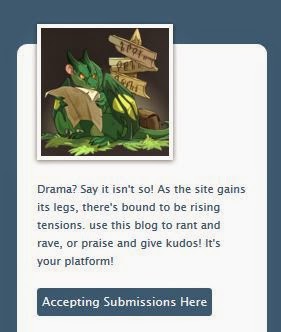
This time, I’ll be using a blog dedicated to Flight Rising, a virtual petsite similar to neopets but with dragons. It goes by the tongue-in-cheek moniker "Drama Rising".
http://dramarising.tumblr.com/
It’s not solely a confession blog, but it operates in pretty much the same way. Users submit confessions, rants, complaints, observations, or drama anonymously. A lot of the posts are similar to those I outlined in the previous discussion on confession blogs, so I won’t rehash an old subject. Instead, I’ll be focusing on some of the differences, mainly that there are no rules or apparent moderation on Drama Rising, which allows for completely different types of posts.

Since the posts are mostly unmoderated, a lot of them single out or attack users.


A least they tried to keep the target somewhat anonymous?

As a result, other posters might in turn retaliate against an anonymous rant on the same blog. There is no room for vague phrases like “some users” or “the fandom” that you might find on confession blogs with strict rules. These are targeted messages.


Any policing of the behavior on this blog are completely community driven. Anonymous users will try to attack or shame other posters to keep others in line.


Such tactics make work to some degree and possibly change behavior. But it also creates a lot of hostility that may result in fewer users wanting to participate (especially by those who are specifically named in posts) or even stronger retaliations from others. No one likes being told what to do or how to behave, after all. Not to mention, with no explicit rules, the unspoken expectations for behavior become inconsistent at best. It just makes people squabble more about what should be considered unacceptable or unnecessary content. Yes, the setup allows for more variety of posts, but the tradeoff comes with a more vitriolic community.  

Friday, February 27, 2015

Internet Hate Machine

CW: Vulgar language and verbal threats
For all the venues of communication that anonymity affords, there are considerable perils as well. Anyone who has been online long enough knows what I’m talking about. Anonymous hate. It can be fun to leave, but it’s never fun to receive.

The anonymous function at its core separates people from their words, which can be incredibly freeing for most. This fact alone makes many people rally behind the cause of protecting anonymous posting capabilities. They ultimately consider it worth protecting despite all of the consequences that come with it, both the positives and the negatives. And at times, those are almost inseparable. After all, and perhaps most importantly, anon divests the poster from the consequences of their actions. The words appear, but without an apparent author to claim ownership. There’s no easy way to track down the original poster or even identify them. In a large group of anon posts, the confusion easily increases. One person can play the role of multiple anons. They can create a whole thread of different personas having a “conversation” in order to prove a point or purposely create drama.

Of course, sometimes anon hate is isolated and so vague that it’s almost ridiculous. Such messages are easy to dismiss and delete, or even ridicule.


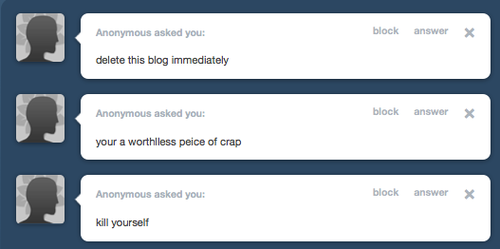
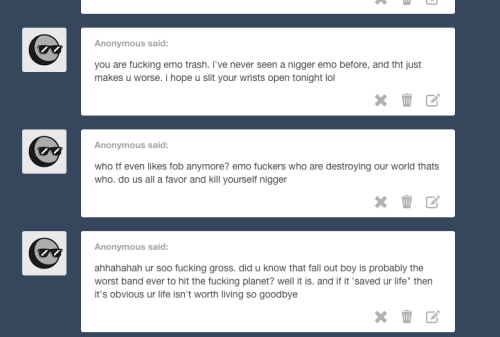
But sometimes anon hate can be unfunny and even destructive. The behavior extends into and escalates in private messages, which often serve as the venue for pointed attacks. Vicious attacks may be mounted against one user through anonymous messaging. Sometimes the attackers really are a number of different users who, for some reason, feel the need to heckle a particular individual. Much more commonly, however, the anon hate all stems from one user sending multiple messages that claim to originate from different people. This tactic purposely ramps up the magnitude of the attack in a way that non-anonymous messaging simply cannot hope to replicate. It breeds paranoia and suspicion and creates a very hostile and unsafe environment for the victim. They have no way of knowing who or how many people are singling them out. And they can’t just block them and move on since it’s all anonymous.

Again, they have no idea who is really attacking them.

It could be anyone. A follower? A fan? A random visitor? A close friend? The last possibility in particular erodes confidence and trust at an individual level, and consequently detracts from community interaction as a whole. Fandom is no exception. Once stung, it is incredibly common and completely understandable that a user would not want to continue participating in that fandom. At worse, the fan might delete their account or leave the community completely.


With sites that enable users to turn anonymous commenting or messages on or off, however, the recipient of anonymous hate frequently just disables those possibilities. It’s a simple enough response, but the restriction leaves some subtle consequences. It closes the user off from more general interaction with fans and shuts down a whole venue of communication. People can no longer, for example, send anonymous confessions or personal messages to that user without outing themselves. As such, they are more likely to just avoid any attempts at communication with that user in general.

Anon can be a great tool. But like any tool, it can be misused. And the consequences can affect everyone.

Monday, February 23, 2015

A syllabus? On fanfiction? It's more likely than you think.


When fandom and academics collide it typically isn’t pretty, as yesterday’s drama clearly shows us.

This year, the University of California Berkley decided to try something different in its curriculum. They went for a bold, new foray into a subculture that has only recently been gaining more visibility in the mainstream. A subculture that has often been framed by the news as an oddity or sideshow. A subculture that changes rapidly thanks to digital media, causing almost any new academic papers on it to seem outdated almost right as they are published. Yes, you guessed it. The university built a course for studying fandom. Specifically fanfiction.

And they're rather proud of it.

Called The Theory of Fanfiction, the class is dedicated to studying the phenomenon and tropes of fandom generated literature. Most of the structure rests on students reading a number of selected fanfictions, or assigned readings if you will. They are then tasked with reviewing said fics and discussing them in the classroom under the direction of a instructor (really a group of student-teachers). The fanfiction selection alone raises some eyebrows. There simply is little precedence for such a small list in academia and such an overwhelming amount of fanfic in general. What exactly determines what fic makes the cut? The popularity or infamy? Cross referencing a number of rec lists? The teacher’s personal favorites? And if that selection process is not bizarre enough, some of the readings are strangely enough paired with more classical readings. The discussion of the infamous badfic My Immortal, for instance, is paired with an excerpt from Dante’s Inferno. I cringe to think of what parallels the class might force. But I digress. The class setup sounds simple and harmless enough. Granted, the academic value of such a class is debatable, but their hearts are in the right place. Right?

If the class had continued on in its own little bubble, then sure. Probably. Few would probably have even known about the course’s existence. But more than a few feathers have been ruffled the past couple of days when the students started leaving the mandatory reviews. What really caught one fic author’s attention was the sudden influx of strangely formatted reviews. Instead of the typical more personal and informal reviews (like a standard “Great fic! I can’t wait for the next update! :D”), tumblr user waldorph noticed a bunch of oddly long and stilted reviews full of formal language and attempts at constructive criticism on their ao3 page, even though they did not ask for any.

The author and other non-student reviewers did not take kindly to the intrusion for a number of reasons. First and foremost, none of the fic authors were asked or notified about the course and the use of their works in said course. This was a huge mistake on the side of the professors, especially since 50% of the students grades rely on fandom interaction through reviewing. The authors likely did not want the sudden influx of attention from outsiders. The reviewers themselves were obviously not used to the understood but unstated etiquette of fanfic. Mostly, that the reviews aren’t really reviews in the way that most people tend to think of them. Unless the author specifically states that they want constructive criticism, most of the time people won’t leave any as it would be considered rude. Fanfiction, after all, is not meant to be rigorously scrutinized the way an academic paper might. It’s not made for publishing and should not be treated as such. It’s first and foremost for fun.

One anonymous user sums it up nicely when addressing the student-teacher (who was forced to explain when the comments turned to mudslinging and attacks on BOTH sides):

http://archiveofourown.org/works/839637?page=3&show_comments=true&view_full_work=false#comments
Full thread here.

Things have cooled down a bit, or as best as it can in a scant 24 hours, but the drama has stirred up a lot of important discussion on the intersection of academia and fandom culture and especially on how the former should respectfully approach the latter. Careful thought should definitely go into exploring these issues to prevent another incident from occurring in the future.

A full write-up of the drama can be found here. And more discussion on the topic can be found here, here, and here. Keep in mind that the fallout is still unfolding, so there may be a future update.

Sunday, February 15, 2015

Pseudonym Sunday: Gaining Reputation and BNFs

People like having fans. And fans definitely like having fans.

While that may seem weird and counterintuitive at first, there is a perfectly good explanation. It mostly stems from the fact that many fans become content creators themselves, even if they end up borrowing someone else’s characters, worlds, and/or scenarios to do so. They produce fanworks like fanfiction, fanvids, and fanart without any intention of making a profit. It’s just for fun. And if the work is of a high enough quality and well received, it’s very likely that the person will gain their own following of other fans.

Even though this is a Pseudonym Sunday post, don’t let the category trip you up. Even anonymous users can gain a fan following if there is an easy way to attribute certain works or comments to one individual, anonymous or not. Art styles, for example, may be easy to identify and match up. Or, an anonymous user might claim a number of works as theirs without divulging their name. Pseudonyms just make this process easier and more accurate. After all, they give a distinct name and ownership to the work.

When a fan gets a big enough reputation, people might start considering them as a Big Name Fan, or BNF. This is where the terminology gets a bit tricky. It definition is simple enough. For whatever reason, BNFs are simply well-known fans. Just note that it’s not always the result of pure hard work and talent. There are a lot of other factors that can come into play before someone might be labeled a BNF. But the connotations can range from well to ill received. The positive side of the coin is easy enough to see, so I will be focusing mainly on the negatives.

http://fuckyeahfanficflamingo.soup.io/post/166328089/BNF-USES-UNIQUE-DESCRIPTION-IN-PORN-SCENE
 BNFs can have A LOT of influence.

To put mildly, BNFs become centers of their fandom and become very influential in their own niche of the subculture. They're trend setters. And as a result, they often gain a sort of cult-like following and may use their popularity immorally. It’s mainly a symptom of attaining fame and being put on the spotlight. For better or worse, people flock and look up to the BNF, even idolize them, and not everyone can handle such power. The position also leaves them open to drama. Generally speaking, the more popular someone is, the more likely people will want to tear that person down by stirring shit up, and fandom spaces are no exception. The fallout of such drama can be legendary.

Because of the reputation of the title, few like to use it, especially when referring to themselves. Nobody Ever Admits They’re a BNF:

Nobody ever admits they're a Big Name Fan. It's part incredulity, part modesty, and part self-preservation, usually in that order. The first time you hear somebody call you a BNF, it's ridiculous. I mean, come on- you're just some random schlub who writes stories/makes art/makes vids/talks about the show, BNF? Please! It's funny, too, because then you can have polls in your journal and ask for minions, because the notion of you being a BNF is so ridiculous it's mockable. Mockity, mock, mock!
Then, it's modesty. Because you're not stupid- you can look at your friends list and realize that 400 people is more than 50 people, and therefore, more people are reading what you say. (At least, in theory.) Still, 400 people reading what you say- that's hardly anything to get uppity about. Other people have bigger friends lists. Other people write more popular stories. You're still some random schlub writing stories, making art, making vids, talking about the show, you're just a random schlub that has more than your best friend listening.
Then, it's self-preservation, because there comes a point when denying your BNFness is, to choose the favoritest words of all fandom words used to describe a liar, disingenuous. Now, you're still a random schlub, because you always were a random schlub. But by this point, you are a random schlub whose name gets used as an example for various compare, contrast exercises and your behavior is part of the Neilsen Data for your particular fandom, along with the other BNFs'. Never mind that the statistical margin of error is like 90 percent, the rep of the fandom, that's on you. You know you're a BNF, but you know better than to admit it.

There are a lot more nuances and controversies about the term that I've glossed over for the sake of time and coherence. BNF, for example, is becoming more a slippery term and possibly outdated, even if the concept still stands. The shift of fandom culture from sites like livejournal and fanfiction.net to tumblr and AO3 have certainly complicated it. More information and opinions can be found here and here.

Before concluding this entry, I should really emphasize that the popularity of one fan does not necessarily guarantee quality. There are a ton of underappreciated or lesser known fans churning out wonderful works. They might just not have that star quality, whether it’s self-marketing or charisma or something else, that vaults certain individuals into BNFdom. And that’s ok. Sometimes the merit of a work just speaks for itself.