Showing posts with label confessions. Show all posts

Monday, March 2, 2015

Hateful Confessions or Venting?

A few weeks ago I gave a general introduction to confession blogs and how people used them, but I talked about them in a mostly positive light, which makes sense. I didn’t want to scare people off from them by highlighting the negatives. That’s more of a second post deal.

The example that I gave last time was of a Dragon Age confession blog, which the owners carefully moderate. The blog contains a clearly visible set of rules that the owners actively enforce for submissions and behavior in order to keep a safe and welcoming environment. But not all confession blogs are structured in the same way. Some advocate for much looser community behavior and standards. They don’t bother with including any submissions guidelines, and the culture they cultivate looks a lot more different as a result.

This time, I’ll be using a blog dedicated to Flight Rising, a virtual petsite similar to neopets but with dragons. It goes by the tongue-in-cheek moniker "Drama Rising".
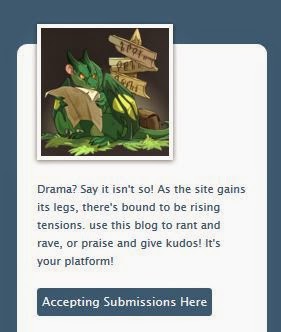
http://dramarising.tumblr.com/
It’s not solely a confession blog, but it operates in pretty much the same way. Users submit confessions, rants, complaints, observations, or drama anonymously. A lot of the posts are similar to those I outlined in the previous discussion on confession blogs, so I won’t rehash an old subject. Instead, I’ll be focusing on some of the differences, mainly that there are no rules or apparent moderation on Drama Rising, which allows for completely different types of posts.

Since the posts are mostly unmoderated, a lot of them single out or attack users.


A least they tried to keep the target somewhat anonymous?

As a result, other posters might in turn retaliate against an anonymous rant on the same blog. There is no room for vague phrases like “some users” or “the fandom” that you might find on confession blogs with strict rules. These are targeted messages.


Any policing of the behavior on this blog are completely community driven. Anonymous users will try to attack or shame other posters to keep others in line.


Such tactics make work to some degree and possibly change behavior. But it also creates a lot of hostility that may result in fewer users wanting to participate (especially by those who are specifically named in posts) or even stronger retaliations from others. No one likes being told what to do or how to behave, after all. Not to mention, with no explicit rules, the unspoken expectations for behavior become inconsistent at best. It just makes people squabble more about what should be considered unacceptable or unnecessary content. Yes, the setup allows for more variety of posts, but the tradeoff comes with a more vitriolic community.  

Friday, February 27, 2015

Internet Hate Machine

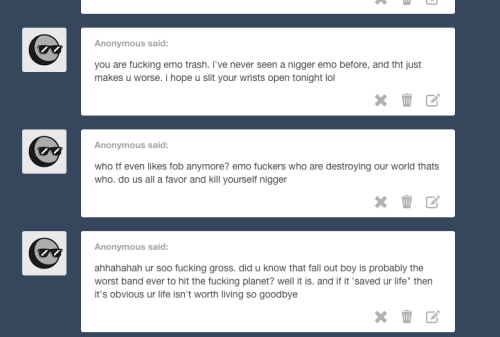
CW: Vulgar language and verbal threats
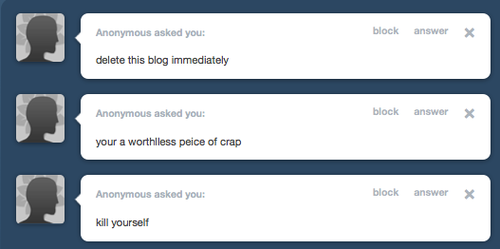
For all the venues of communication that anonymity affords, there are considerable perils as well. Anyone who has been online long enough knows what I’m talking about. Anonymous hate. It can be fun to leave, but it’s never fun to receive.

The anonymous function at its core separates people from their words, which can be incredibly freeing for most. This fact alone makes many people rally behind the cause of protecting anonymous posting capabilities. They ultimately consider it worth protecting despite all of the consequences that come with it, both the positives and the negatives. And at times, those are almost inseparable. After all, and perhaps most importantly, anon divests the poster from the consequences of their actions. The words appear, but without an apparent author to claim ownership. There’s no easy way to track down the original poster or even identify them. In a large group of anon posts, the confusion easily increases. One person can play the role of multiple anons. They can create a whole thread of different personas having a “conversation” in order to prove a point or purposely create drama.

Of course, sometimes anon hate is isolated and so vague that it’s almost ridiculous. Such messages are easy to dismiss and delete, or even ridicule.


But sometimes anon hate can be unfunny and even destructive. The behavior extends into and escalates in private messages, which often serve as the venue for pointed attacks. Vicious attacks may be mounted against one user through anonymous messaging. Sometimes the attackers really are a number of different users who, for some reason, feel the need to heckle a particular individual. Much more commonly, however, the anon hate all stems from one user sending multiple messages that claim to originate from different people. This tactic purposely ramps up the magnitude of the attack in a way that non-anonymous messaging simply cannot hope to replicate. It breeds paranoia and suspicion and creates a very hostile and unsafe environment for the victim. They have no way of knowing who or how many people are singling them out. And they can’t just block them and move on since it’s all anonymous.

Again, they have no idea who is really attacking them.

It could be anyone. A follower? A fan? A random visitor? A close friend? The last possibility in particular erodes confidence and trust at an individual level, and consequently detracts from community interaction as a whole. Fandom is no exception. Once stung, it is incredibly common and completely understandable that a user would not want to continue participating in that fandom. At worse, the fan might delete their account or leave the community completely.


With sites that enable users to turn anonymous commenting or messages on or off, however, the recipient of anonymous hate frequently just disables those possibilities. It’s a simple enough response, but the restriction leaves some subtle consequences. It closes the user off from more general interaction with fans and shuts down a whole venue of communication. People can no longer, for example, send anonymous confessions or personal messages to that user without outing themselves. As such, they are more likely to just avoid any attempts at communication with that user in general.

Anon can be a great tool. But like any tool, it can be misused. And the consequences can affect everyone.

Friday, February 13, 2015

On Fandom Confessions and Blogs

Everyone has secrets that they wish they could tell to someone confidentially. But often there's no one to tell safely. Sometimes friends and family are just too close or it would be too embarrassing to tell someone you interact with regularly. That's why people go to therapists or contact anonymous hotlines. It's liberating to simply get it off your chest without any fear of judgment.

If you've been following this blog at all, it should be unsurprising to learn that such behavior persists in a fandom environment. Fans frequently want to reveal their desires, opinions, and experiences. These confessions just deal with fandom related content and tend to collect on blogs specifically created for them.

People use such spaces to anonymously confess for any number of reasons and the responses vary greatly. To use a Dragon Age blog as an example,

Some deal with the mundane:

http://dragonageconfessions.tumblr.com/post/110829678223/confession-say-what-you-will-about-merideth-but

 Give an unpopular opinion that the user might fear being harassed over:

http://dragonageconfessions.tumblr.com/post/110837383895/confession-i-get-sad-when-some-people-say

Explain an embarrassing mistake or misunderstanding:

http://dragonageconfessions.tumblr.com/post/110549325716/confession-because-of-his-white-hair-hunched

Relate the original media to their daily life:

http://dragonageconfessions.tumblr.com/post/110630897126/confession-i-understand-how-people-can-feel

Reveal a very personal part of themselves:

http://dragonageconfessions.tumblr.com/post/110738491583/confession-i-absolutely-love-seeing-how-well

Or virtually any other reason. There's no reason to worry. They're all anonymous!

If you follow any of the links, one of the first things you'll notice about the blog is the set of loose rules in the about box on the side. These guidelines are further explained in a separate page. Despite its anonymously submitted content, there is some methodology that keeps the tumblr from running completely into anarchy. It's a relaxed sort of moderation, almost anything goes, but it keeps drama, hostility, and abuses to a minimum. It keeps a level of civility.

For example, one rule states that:

Under no circumstance will confessions relating to hate speech about a particular out of game (or some in game) race, religion, sexual orientation, gender, or any other be published.  They will be deleted from our inbox without comment.

Such guidelines keep the blog as a safe space. Potential submitters will not be run off because of racist, misogynistic, anti-semitic, or any other sort of hate speech derived content. Anyone and everyone is welcome to participate, regardless of their identity or background. It keeps users from pointedly targeting other users or groups. The rules simply help to enforce this healthy environment. While they're not universally applied to every confession blog, similar guidelines are found on almost every popular one.

If there's a confession to be had, there's a method available. For almost everyone. Including fans.